
Cover image: A klimArt school master plan. Orientation, shading and green cover are set at the design stage, before construction begins. Design visualization.
The design of a classroom can explain about 16% of a child's academic progress in a year. Not the teacher. Not the syllabus. The room itself.
That figure comes from one of the most rigorous studies conducted, and it points to something most of us overlook. We give enormous attention to curriculum, teachers and technology, and treat the building that holds all three as a neutral stage. The evidence says it is not neutral. It is an active part of how well the children inside it learn.
What the evidence shows
Researchers at the University of Salford assessed 153 classrooms across 27 schools and tracked the progress of 3,766 pupils. After separating the influence of the building from the influence of the pupils and their teachers, they found that physical classroom design accounted for sixteen percent of the variation in learning progress over a single year. To put that in human terms, moving an average child from the least effective room to the most effective one delivered a meaningful share of a full year's expected progress. The factors that carried the most weight were not decorative. They were light, temperature and air quality.

Daylight, studied on its own, tells the same story. In a landmark study of more than twenty one thousand pupils across three school districts, children in the most daylit classrooms progressed twenty percent faster in mathematics and twenty six percent faster in reading over a year than those in the least daylit rooms. When an independent body later reanalyzed the data to test for teacher bias, the effect held. A separate study across hundreds of European classrooms reached the same conclusion from a different direction.
Why the room changes the result
None of this is mysterious once stated plainly. A child who is too warm loses focus. A poorly ventilated room lets carbon dioxide build through a lesson, which dulls alertness. Glare makes a board hard to read, and uncontrolled noise fragments attention. Poor air raises absence, and a child who is not in the room cannot learn in it. These are not matters of comfort or decoration. They are the daily conditions under which concentration either holds or slips.
The decisions are made early
For anyone who commissions a school, this is the part that matters most. Almost every one of these factors is set at the concept and design stage, through decisions about orientation, window placement, ceiling height and ventilation. They cost very little to design in and a great deal to correct later. A shading detail is inexpensive on a drawing and expensive once the walls are standing. In effect, how a classroom performs for the next several decades is largely decided in its first weeks on paper, before a single child arrives.

This is the principle we design around. We treat the performance of a learning space as a decision made at the start, not a rating pursued at the end. It is the thinking behind our work on the PSBB LLA School in Bangalore, recognized for a master plan and a low-carbon design shaped around its climate rather than retrofitted to it.
An Indian classroom raises the stakes
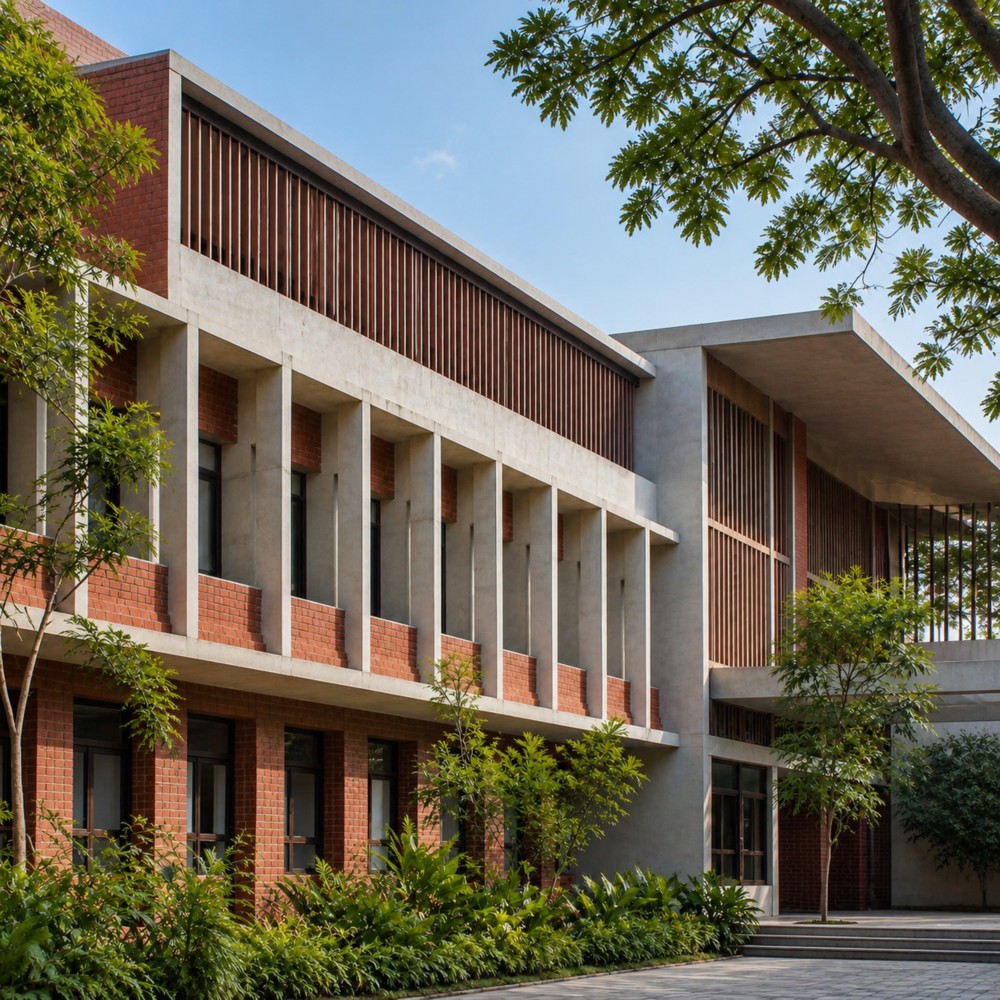
In the Indian climate heat, humidity, glare and air quality, for much of the year, are the defining daily conditions of a classroom. A school planned without a careful reading of its climate asks its students to concentrate through discomfort the design could have removed. One planned with that reading gives them a cooler, quieter, better lit room to think in, without relying on mechanical systems to rescue a plan that ignored the sun.
We already accept that a good teacher changes outcomes. The evidence now says the room does too, and that its contribution rests with the architects and the boards who commission them. That is a responsibility worth taking as seriously as the curriculum.
If you lead a school or a campus, there is one question worth asking of any building you plan or renovate. Was it designed around the timetable, or around the child who will spend twelve years inside it?
klimArt designs learning environments across India, from campus master plans to individual schools, with building performance considered from the first sketch.
Originally published by klimArt Architects on LinkedIn on 11 August 2026.
